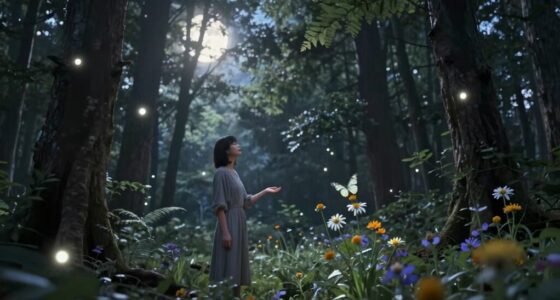
Photographic orbs are most often caused by dust, pollen, or moisture reflecting light from your camera’s flash or lens, creating bright, circular spots in your photos. While some see these orbs as spirits or energy signals, science explains them as camera artifacts influenced by environmental factors like humidity and lighting. If you stay curious and look deeper, you’ll discover how understanding physics and photography mechanics can clarify these mysterious spots.

Turn your quiet moments into listening time
- Thousands of audiobooks, podcasts and originals
- Listen on your phone, tablet or Echo — also offline
- Cancel anytime
Key Takeaways
- Most orbs are caused by dust, pollen, or moisture reflecting light in low-light or indoor conditions.
- The shape, size, and movement of orbs can indicate whether they are environmental particles or potential paranormal signals.
- Environmental factors like humidity and lighting influence the appearance and frequency of photographic orbs.
- Scientific explanations attribute orbs to camera artifacts rather than spirits or supernatural activity.
- Careful analysis of context and environmental conditions helps distinguish dust specks from possible spirit signals.

Camera artifacts are a common explanation for orbs in photographs. They occur when particles like dust, pollen, or moisture get caught in the camera’s flash or lens, reflecting light back into the camera sensor. These tiny particles, especially when close to the lens, can produce bright, circular spots that seem to glow or shimmer in photos. Such orbs are often blue, white, or yellow, and their appearance correlates with the presence of dust or moisture in the environment. When you review your images, you might notice that these orbs appear more frequently in indoor settings or in low-light conditions where the camera’s flash becomes more active. They are simply the result of everyday camera artifacts, and understanding this helps demystify many of these glowing spheres. Additionally, research into environmental factors shows how humidity and lighting can influence the visibility of these orbs in photographs.
However, some people interpret orbs differently, especially in the domain of paranormal interpretations. For those inclined toward the supernatural, these glowing spheres are seen as spirits or energy manifestations. They believe that orbs are the remnants of souls, manifestations of spiritual activity, or signs of otherworldly presence. Paranormal enthusiasts often point out that these orbs sometimes appear in specific locations, during séances, or in places with a history of ghostly activity. They argue that the shape, size, and movement of these orbs can indicate whether they’re just camera artifacts or something more significant. Skeptics, on the other hand, point out that many of these claims lack scientific backing, and that the majority of orbs can be explained by simple physics and camera limitations.
In the end, whether you see these glowing spheres as dust specks or signals from beyond depends on your perspective. Scientifically, they are mostly camera artifacts caused by environmental particles and lighting conditions. Yet, for some, these orbs carry a deeper, spiritual meaning. The key is to analyze each photograph carefully, consider the context, and keep an open mind. Whether you view them as mundane dust particles or mysterious spiritual signals, understanding the nature of camera artifacts helps you appreciate the nuances of capturing the unseen world through your lens.
As an affiliate, we earn on qualifying purchases.
Frequently Asked Questions
Can Orbs Be Captured in Professional Studio Photography?
You can definitely capture orbs in professional studio photography. When you use studio lighting, especially with bright flashes or strong side lighting, orbs can appear on your images. Sometimes, lens flare from intense light sources creates orb-like shapes, making it tricky to distinguish between dust specks and genuine orbs. To avoid this, you should control your lighting and check for dust on your lens, ensuring the orbs are intentional or authentic.
Do Different Colors of Orbs Signify Different Spirits?
Imagine each colored orb as a whisper from the spirit world, painted in shades that symbolize different energies. While some believe color symbolism can hint at specific spirits or messages, there’s no scientific proof. You might see a blue orb as calm communication or a red one as passion. Ultimately, these colors serve as a language of spirit communication, but interpret them with an open mind, knowing their true meaning remains personal and subjective.
How Can I Differentiate Between Dust and Genuine Spirit Orbs?
To tell apart dust particles from genuine spirit orbs, look closely at your photos. Dust particles and light reflections usually appear as small, irregular, or moving specks that shift with camera angle or lighting. Spirit orbs tend to be more uniform, often glow softly, and remain in consistent positions or move intentionally. Trust your intuition and observe patterns to distinguish between harmless dust and meaningful spirit signals.
Are Orbs Visible Without a Camera?
You might wonder if orbs are visible without a camera. Usually, dust particles and camera artifacts aren’t seen with the naked eye because they’re tiny and only show up in photos. Sometimes, bright orbs are visible in specific lighting or conditions, but most commonly, you need a camera to capture them. If you see something unusual in person, it’s likely not an orb but a natural phenomenon or light reflection.
What Are the Scientific Explanations for Photographic Orbs?
You might wonder about photographic orbs and their scientific explanations. Many believe they’re spirit signals, but photography myths often suggest they’re just dust, pollen, or moisture caught in the camera’s flash. These orbs are optical illusions caused by particles reflecting light, especially in low-light conditions. Understanding this helps you see how illusions, rather than supernatural activity, create the mysterious appearance of orbs in photos.
As an affiliate, we earn on qualifying purchases.
Conclusion
So, next time you see those mysterious orbs in your photos, consider the evidence. While dust specks are the simplest explanation, some believe they’re signals from spirits reaching out. Scientific tests lean toward dust particles reflecting light, but the idea of spiritual energy adds an intriguing layer. Ultimately, whether they’re just dust or something more, these orbs remind us that some mysteries might never be fully explained—keeping us curious and open-minded.
As an affiliate, we earn on qualifying purchases.
As an affiliate, we earn on qualifying purchases.
Fall Picks
fall essentials
As an affiliate, we earn on qualifying purchases.