
TL;DR

Get books, candles and calm essentials delivered free — and shop member deals
- Fast, free delivery on millions of items
- Access to Prime Big Deal Days deals on October 6–7
- Prime Video, Amazon Music and more included
Meditation and mindfulness tools range from free practices such as mindful walking to guided apps and wearable devices. Choose based on comfort, accessibility, privacy, and whether you will use the tool regularly; no app or device is required, and mindfulness is not a substitute for healthcare.
Your mind can wander in the middle of a meditation, and that doesn’t mean the practice has failed. Noticing the wandering and gently returning your attention is often the practice itself.
Meditation and mindfulness tools can help you learn that skill, but they range from a free walk around the block to a paid app or smartwatch. You don’t need special equipment, perfect silence, or an empty mind to begin.
This guide explains what the tools do, how to choose one that fits your life, and what to watch for around privacy and wellbeing. You’ll also find simple ways to start without turning meditation into another demanding task on your to-do list.
Mindfulness means noticing present-moment experience; meditation is a family of practices that can help you train attention and awareness.
You can begin without equipment or an app, using a timer, a short breath practice, or mindful walking.
Start with a repeatable two-to-five-minute session and change the method if sitting still or focusing on breath feels uncomfortable.
Treat wearable stress and sleep scores as estimates, not measures of your mindfulness or a diagnosis.
Check an app’s data practices and pause or adapt any practice that worsens distress.
Know what mindfulness and meditation actually mean
Meditation and mindfulness tools help you practice attention, but the two words describe related ideas rather than identical things. Mindfulness generally means paying attention to what is happening now with greater awareness and less automatic judgment; meditation is a family of practices that can cultivate attention, awareness, or other mental qualities.
In a breath-awareness meditation, for example, you might notice the air at your nostrils, realize you’re planning dinner, and return to the breath. The aim is not to force your brain into silence. It’s more like noticing that a radio is playing in another room: you hear it, but you don’t have to follow every song.
That distinction matters when you choose a tool. A guided meditation provides a structured exercise, while a mindful moment can happen without instructions in the middle of an ordinary activity. The guide may make it easier to know what to do, especially when starting out; the tradeoff is that you may come to rely on audio, a particular voice, or a quiet setting. Everyday mindfulness is more flexible, but it can be harder to remember without a cue.
Mindfulness can also happen outside a formal session. You might notice the warm mug in your hands, the bitter first sip of coffee, and your shoulders creeping toward your ears before a meeting. A meditation practice gives you a dedicated chance to rehearse paying attention; mindful moments can bring that attention into ordinary life.
Common approaches include breath awareness, body scans, mindful walking, loving-kindness meditation, and guided imagery. They won’t all suit everyone. If closing your eyes feels uncomfortable, keep them open; if sitting still feels restless, walk slowly and notice your steps. Different anchors direct attention in different ways: the breath and body turn attention inward, while sounds or walking keep more awareness connected to the surroundings. The useful question is not, “Am I doing the one right method?” but, “Can I practice this in a way that feels manageable?”
guided meditation app for beginners
As an affiliate, we earn on qualifying purchases.
As an affiliate, we earn on qualifying purchases.
Compare free practices, guided apps, and wearables
Meditation and mindfulness tools fall into three broad groups: simple no-cost practices, guided apps, and devices that track body signals. Each can help you get started, but none works for every person or every situation. A phone may offer clear instructions; a quiet walk may feel more comfortable than staring at a screen.
| Tool | What it offers | Good fit when | Watch for |
|---|---|---|---|
| Free practice or timer | Breath, walking, or a simple bell | You want a low-cost, flexible start | You may need written guidance at first |
| Guided app | Audio sessions, courses, reminders, or sleep content | You like a teacher’s voice and clear structure | Subscriptions, data collection, and notification clutter |
| Wearable | Heart-rate or sleep estimates, sometimes practice prompts | You enjoy noticing patterns over time | Scores are estimates, not measures of mindfulness or mental health |
These options differ not just in price but in how much structure and information they add. A timer can mark the beginning and end of a session without steering your attention, leaving you free to build a self-directed habit. That simplicity protects privacy and avoids screen distractions, but beginners may feel unsure what to do when thoughts wander. An app can fill that gap with prompts and a teacher’s voice, although the structure may feel distracting or prescriptive if the pace or approach does not suit you.
A wearable can make body signals easier to notice over time, but adding measurements can change the experience: instead of attending to what you feel, you may start checking whether a number says you are relaxed. The device can be useful as a prompt, but it cannot tell you whether the practice was meaningful. For example, a beginner who gets distracted by a phone may prefer a kitchen timer and a printed prompt. Someone who feels unsure about what to do may appreciate a five-minute audio session. Tools range from simple bells to guided apps and wearable devices, but price does not guarantee a better fit.
Compare cost, language, session length, accessibility features, and instructor style before paying. A free trial can help you judge whether the voice and pace feel comfortable. Read the privacy settings, too, especially if an app asks you to record moods, speak into a microphone, or share health-related information. Consider the ongoing cost and attention demands as well as the advertised features: an app you use comfortably for free may be more useful than a premium one that adds reminders and tracking you do not want.
As an affiliate, we earn on qualifying purchases.
Choose a beginner practice you can repeat
Meditation and mindfulness tools are easier to keep using when they fit a routine you already have. There is no universally ideal session length; a few minutes practiced regularly may feel more manageable than an occasional long session. Start small enough that you can repeat the practice on an ordinary Tuesday, not just on a perfectly quiet weekend.
- Choose one anchor. Notice your breath, the feeling of your feet on the floor, or sounds in the room.
- Pick a short window. Try two to five minutes while your kettle boils or just before lunch.
- Set a gentle cue. Use a plain timer, a calendar reminder, or a note beside your mug.
- Notice and return. When your attention wanders, acknowledge it and come back to your chosen anchor.
- Adjust after a few tries. If sitting feels uncomfortable, try a slow walk or a body scan instead.
Imagine that you have three minutes before joining a video call. You sit with your eyes open, feel your feet on the floor, and notice one breath at a time. Your mind rehearses what to say; you notice that, then return to the pressure of your shoes against the ground. That small repeatable routine may be easier to maintain than a 30-minute session you keep postponing.
Keeping a session short lowers the effort needed to begin, but short practice is not a promise of a particular result. Its practical value is that it gives you a manageable chance to learn the routine and notice how it feels. If you consistently find yourself rushing or uncomfortable, lengthening the session may not solve the problem; changing the time, anchor, or posture could make practice more workable.
A reminder can help, but it should serve you rather than nag you. If a notification brings guilt instead of support, turn it off and connect practice to an existing habit, such as washing your hands before lunch. A routine is a helpful cue, not a test of discipline.
As an affiliate, we earn on qualifying purchases.
Know what progress can feel like—and when to pause
Meditation and mindfulness tools do not need to make you feel calm for your practice to count. You may notice restlessness, boredom, sadness, or a busy stream of thoughts. Progress can look like recognizing what is happening and choosing a kind, manageable response rather than judging yourself for having a mind.
This is useful because treating calm as the sole measure of success can turn ordinary reactions into reasons to feel inadequate. A session may bring thoughts or feelings into awareness without making them disappear. You can consider whether you noticed your experience and responded safely, rather than asking whether you reached a special state or completed a streak.
For example, you start a body scan hoping to relax after a difficult day, but your jaw tightens and an upsetting memory comes up. You can open your eyes, switch to noticing sounds around you, stand up, or stop the session. You do not have to push through discomfort to prove you are doing it correctly.
Research has examined mindfulness-based programs for outcomes such as stress, anxiety, pain, and sleep, but results vary by person, program, and condition. A program may support wellbeing for some people; that does not make it a guaranteed fix or a replacement for diagnosis and treatment. Keep expectations modest, and talk with a qualified healthcare professional about concerns that affect your wellbeing.
A difficult session is a reason to adjust, not a reason to blame yourself. If a practice makes symptoms worse or leaves you distressed, pause, choose a gentler approach, or seek qualified support.
That may mean trying shorter sessions, moving with your eyes open, or choosing an activity-based practice. If you already receive care for a mental or physical health concern, mindfulness can be a topic to discuss with your care provider. Your comfort and safety matter more than completing an app streak.
As an affiliate, we earn on qualifying purchases.
Check privacy and treat device scores as estimates
Meditation and mindfulness tools can collect more information than a simple timer, so check what an app or device asks you to share before making it part of your routine. Mood logs, voice recordings, sleep histories, and account details can reveal personal patterns. A soothing interface does not tell you how a company stores or uses your data.
Before signing up, look for plain explanations of what data the service collects, why it collects it, whether you can delete it, and whether it shares information with other companies. Ask whether the app needs microphone access or location data for the feature you want. If a basic audio session works without creating an account, that may be the simpler choice.
This is a tradeoff between convenience and disclosure. A mood log might help you reflect on patterns, for example, but it also creates a record of sensitive information. Sharing only what a feature genuinely needs can reduce exposure without giving up the parts of the tool you find useful. Privacy settings and data policies can change, so it is worth checking them again if the app adds features or asks for new permissions.
Wearables add another layer: some show heart rate, sleep estimates, or a “stress” score alongside mindfulness prompts. Those readings can help you notice patterns, such as higher readings after a late night, but they are not direct measures of mindfulness or mental health. A single number cannot tell you the whole story of how you feel.
Picture checking a watch after a relaxing walk and seeing a high stress score. You might be warm from the sun, have just climbed stairs, or simply be seeing an imperfect estimate. Use the number as a prompt to notice your own experience, not as a verdict. If a metric makes you anxious or pushes you to chase a perfect score, hide it or stop tracking. The information is only useful if it supports your choices rather than overriding your own judgment.
Make the practice fit your real life
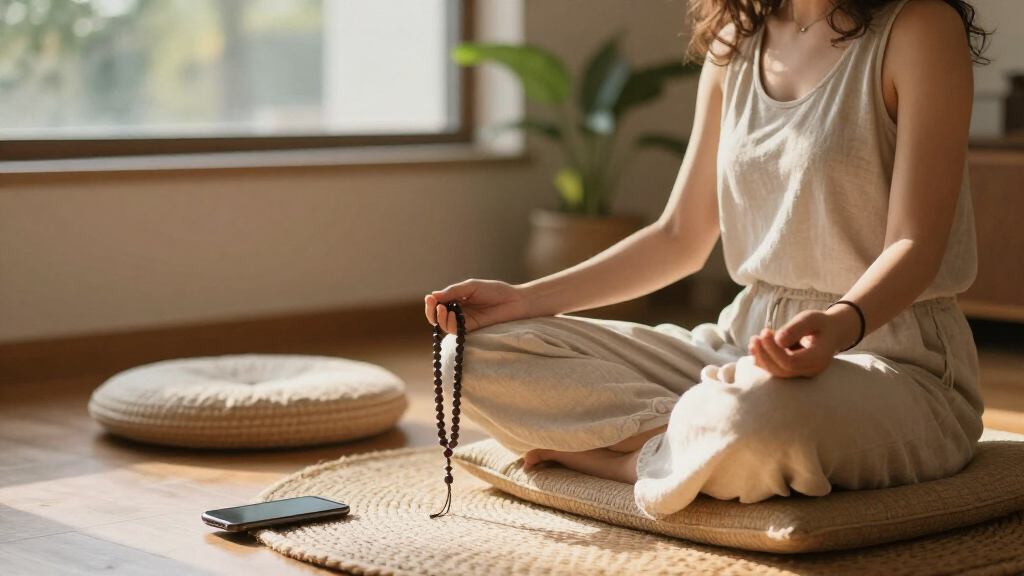
Meditation and mindfulness tools work best as options you can adapt, not rules you must obey. A useful tool respects your time, body, budget, and preferences. If you live with children, shift work, limited space, or mobility constraints, a five-minute practice in a chair may be more realistic than a quiet room and a floor cushion.
Making practice fit your circumstances matters because an ideal setup that rarely exists is hard to sustain. A chair, open eyes, or a brief activity-based exercise may offer less quiet than a dedicated meditation space, but it can make practice accessible when your day is crowded. Accessibility is not a lesser version of the practice; it is part of choosing a form you can actually use.
For a busy parent, mindful hand-washing might be the only quiet moment before the school run: feel the warm water, hear it patter against the sink, and notice the soap’s scent. If you work at a desk, you could take a short walking break and feel each foot land. These are small examples, but they put attention into a day that already exists.
Guided apps and workplace or school programs vary in quality and purpose, so check what they actually provide. A course with trained instructors and clear limits is different from a service that promises to cure anxiety or guarantee better sleep. Ask who created the material, whether it fits your needs, and what support is available if an exercise feels difficult. An organizational program may also have different privacy expectations than a personal practice, so find out whether participation or personal reflections are shared with anyone else.
Try this low-pressure experiment: use one practice for a week, then ask whether it felt accessible, whether you liked the instructions, and whether it fit your schedule. Keep what helps and change what doesn’t. You are choosing a tool, not signing a contract with one style of meditation.
Frequently Asked Questions
What is the difference between meditation and mindfulness?
Mindfulness means paying attention to present-moment experience with greater awareness and less automatic judgment. Meditation refers to a family of practices that can cultivate attention or awareness. You can meditate formally or bring mindfulness to everyday activities, such as walking or washing dishes.
Which meditation tool is best for a beginner?
The best starting tool is one that feels accessible and comfortable to you. Try a short guided session if instructions help, or use a simple timer and notice your breath or feet on the floor. If sitting still is unpleasant, choose mindful walking instead.
Can I practice mindfulness without an app or equipment?
Yes. You can pay attention to your breathing, the sounds around you, or the feeling of each step without an app or special equipment. A timer can help you keep a short session, but it is optional.
How long should I meditate, and how often?
There is no single ideal duration or schedule for everyone. A few minutes on a regular basis may feel easier to maintain than occasional long sessions, so try a short routine and adjust it to your life. Consistency is a helpful aim, not a pass-or-fail rule.
What should I do when my mind keeps wandering?
Notice that your attention wandered, then gently return it to your chosen anchor, such as your breath or the feeling of your feet. Wandering does not mean you have failed; noticing it is part of the exercise. If focusing inward feels uncomfortable, switch to sounds or a slow walk.
Do meditation apps protect my personal data?
Privacy practices vary by app, so check what information it collects, how it uses or shares that information, and whether you can delete your data. Mood logs, voice recordings, and health-related details deserve particular care. If you only need guided audio, see whether you can use it without sharing more information than necessary.
Conclusion
Choose one practice you can try in a few minutes, in a way that feels comfortable, and repeat it when it fits your day. A timer, a guided audio, or the sensation of your feet on a sidewalk can all help you pay attention; none needs to become another score to chase.
Let the tool support your attention, not judge it. Sometimes the whole practice is noticing the kettle’s hiss, the next breath, and the moment you return.
Halloween Picks
halloween
As an affiliate, we earn on qualifying purchases.